
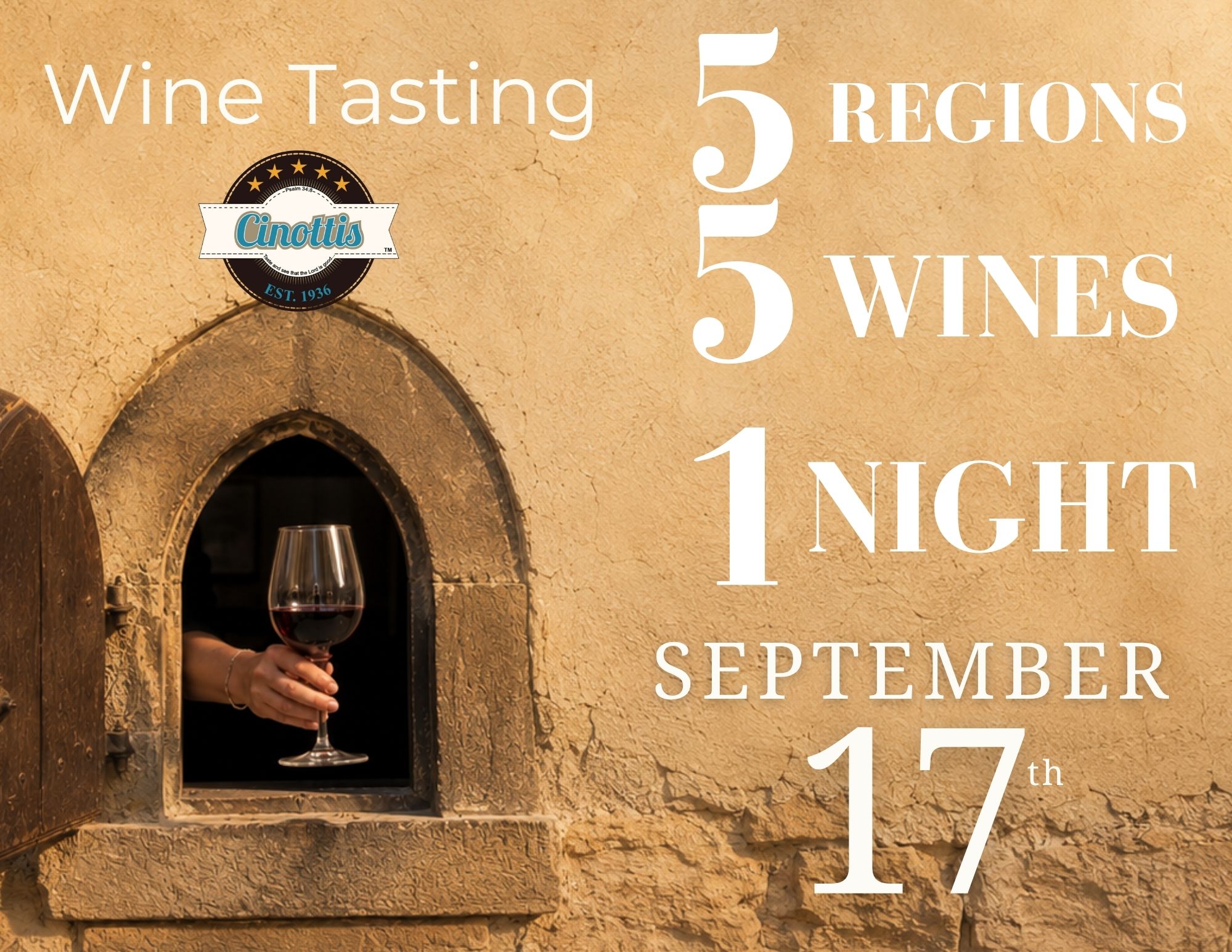
Five Regions, Five Wines, One Night: Take a Tour of Italy at Cinotti’s
There are easier countries to understand through wine than Italy.
Italy is not one of them.
Just when you think you’ve figured out Italian wine, you move a few hundred miles in another direction and everything changes.
The grapes change. The food changes. The landscape changes.
Even the way people talk about wine changes.
And that’s exactly what makes exploring Italian wine so much fun.
On September 17, we’re taking advantage of that diversity and doing something a little different for our next wine tasting at Cinotti’s Bakery & Italian Market.
We’re taking a Tour of Italy.
No passport required.
This time, our itinerary is officially set, and we’ll be traveling through Italy with five very different wines:
- Bervini Prosecco Rosé
- Banfi San Angelo Pinot Grigio
- Tommasi Le Fornaci Lugana
- Umani Ronchi Montepulciano d’Abruzzo
- Bellaria Taurasi Aglianico
We’ll begin with bubbles in northeastern Italy, travel into Tuscany, stop along the shores of Lake Garda, head east into Abruzzo, and finally make our way south to Campania.
Five wines. Five stops. Five completely different expressions of what Italian wine can be.
You Can’t Really Talk About “Italian Wine”
We do it all the time.
We say we’re having Italian food for dinner or opening a bottle of Italian wine.
But imagine trying to describe all American food with one dish.
That’s essentially what we’re doing when we lump all of Italy together.
Italy stretches from the Alps in the north deep into the Mediterranean. Vineyards grow in mountains, along coastlines, across rolling hills, beside lakes, and in volcanic soils.
The climate in northern Italy can look completely different from the climate in Campania.
Naturally, the wines taste different too.
And our lineup is going to give us a chance to experience some of those differences for ourselves.
So let’s look at where we’re going.
Stop One: Veneto & Friuli-Venezia Giulia
Bervini Prosecco Rosé
We’re starting exactly where a good Italian evening should start.
With bubbles.
Our first pour will be Bervini Prosecco DOC Rosé, produced from Glera and Pinot Nero grapes grown across Veneto and Friuli-Venezia Giulia in northeastern Italy.
It’s fresh, fruity, lightly aromatic, and beautifully easy to drink, with floral aromas and notes reminiscent of berries. Bervini recommends it as an aperitivo as well as alongside appetizers, pizza, and seafood starters.
And that makes it a perfect opening glass for our tour.
Before we start thinking about bigger wines, tannins, aging, or complicated grape names, we’re going to do something very Italian.
We’re going to start with a glass of Prosecco and enjoy ourselves.
Stop Two: Tuscany
Banfi San Angelo Pinot Grigio
Our second stop takes us into Tuscany, but perhaps not with the wine you’d expect.
Tuscany is famous for its reds. Mention Tuscan wine and most people immediately think of Chianti, Brunello, or Sangiovese.
We’re pouring Pinot Grigio.
Banfi San Angelo Pinot Grigio Toscana IGT gives us an opportunity to see a completely different side of Tuscany.
Banfi describes San Angelo as a fresh, mineral Pinot Grigio with aromas of apple, peach, citrus, and flowers. The grapes are grown in Tuscany, and the wine pairs particularly well with lighter fish and white-meat dishes.
This is exactly the kind of bottle that makes a Tour of Italy interesting.
If we poured five wines everyone expected, we wouldn’t be doing much exploring.
Instead, Tuscany gets to surprise us.
Stop Three: Lake Garda and Lugana
Tommasi Le Fornaci Lugana
Then we head north again to one of the most interesting stops of the evening.
Lake Garda.
Tommasi’s Le Fornaci Lugana DOC comes from the historic Lugana area on the southern shore of Lake Garda.
And if you’re wondering what grape is in a Lugana, meet Turbiana.
Tommasi’s Le Fornaci is 100% Turbiana, a grape closely associated with the Lugana area. The family’s vineyards sit around Desenzano del Garda and Sirmione, where Lake Garda influences the local growing conditions.
The wine gives us tropical fruit and grapefruit aromas with a dry, fresh palate, minerality, and a characteristic almond note on the finish.
This is exactly why Italian wine becomes so interesting once you stop looking only for familiar grape names.
You might walk past a bottle labeled “Lugana” because you don’t recognize it.
Then somebody pours you a glass.
And suddenly you have a new wine to look for.
Those are some of our favorite tasting moments.
Stop Four: Abruzzo
Umani Ronchi Montepulciano d’Abruzzo
Now we’re ready for red.
Our fourth stop takes us to Abruzzo, along Italy’s Adriatic side, for Umani Ronchi Montepulciano d’Abruzzo.
And here’s an important little piece of Italian wine knowledge:
Montepulciano can be confusing.
In this bottle, Montepulciano is the grape, and Abruzzo is the region.
Umani Ronchi produces several Montepulciano d’Abruzzo wines from 100% Montepulciano grown in Abruzzo. The producer describes the area’s wines as having characteristics that include cherry, spice, and structure, influenced by vineyards positioned between the Gran Sasso mountains and Adriatic Sea.
This is where our tasting starts gaining some weight.
After the bubbles and whites, we’re moving into the darker fruit, body, and tannin of an Italian red.
And we’re not finished yet.
Stop Five: Campania
Bellaria Taurasi DOCG, 100% Aglianico
We’re ending in southern Italy. And we’re not going quietly.
Our final stop takes us to Campania, specifically Irpinia, for Agricola Bellaria Taurasi DOCG.
This is 100% Aglianico, grown in Bellaria’s vineyards in the heart of Irpinia. Their Taurasi is aged for 18 months in French oak barriques and is a structured red designed to pair with foods such as red meats and aged cheeses.
If Prosecco was our opening handshake, Taurasi is our closing statement.
Aglianico can produce powerful, structured, age-worthy wines, and Taurasi is one of southern Italy’s great expressions of the grape.
It’s also a fitting way to end our journey.
We begin light, bright, and sparkling in northeastern Italy.
We finish deep in Campania with Aglianico.
That is quite a trip for five glasses.
Five Wines That Tell Five Different Stories
Look at our lineup together and you begin to understand why saying “I like Italian wine” doesn’t really narrow things down very much.
We have sparkling rosé made with Glera and Pinot Nero.
A Tuscan Pinot Grigio.
Turbiana grown around Lake Garda.
Montepulciano from Abruzzo.
And Aglianico from Campania.
Different grapes.
Different climates.
Different soils.
Different traditions.
Different wines.
All Italian.
That’s the story we want this tasting to tell.
Wine Makes More Sense When Food Is Involved
This is also where Italian wine starts becoming less complicated.
Stop trying to memorize everything and start thinking about the table.
Italian wine and Italian food grew up together.
A sparkling wine before dinner.
A crisp white with lighter dishes.
A more structured white with seafood, cheese, or pasta.
A juicy red beside pasta and a rich sauce.
A powerful Aglianico alongside a hearty dinner or aged cheese.
Suddenly wine becomes much less intimidating.
It becomes part of dinner.
And that’s how we like to approach wine at Cinotti’s.
You Do Not Need to Know Wine to Come
We say this often because we mean it.
Our wine tastings are not wine classes you need to prepare for.
Nobody is going to hand you a test at the end.
You don’t need to know what Turbiana is before you arrive.
You don’t have to know the difference between Montepulciano the grape and Montepulciano the place.
You certainly don’t have to know how to pronounce everything correctly.
And if the person beside you tastes cherries, minerals, almonds, flowers, and the Italian countryside and you’re thinking, “I just know I like it,” that’s perfectly acceptable.
Taste the wine.
Listen to the story.
Ask questions.
Figure out what you like.
That’s it.
Some of our favorite tasting moments happen when someone tries a wine they never would have chosen from a shelf and suddenly looks at the person beside them and says:
“Wait. I really like this.”
That’s why we set up our wine tastings this way.
Why We’re Taking the Tour
When we expanded Cinotti’s into an Italian Market and began growing our wine program, we wanted it to feel like an extension of what our family has always done.
Bring people around a table.
For five generations, we’ve done that with bread, cakes, pastries, sandwiches, and plenty of coffee.
Now we get to do it with Italian food and wine too.
A Tour of Italy feels particularly fitting because it brings together everything we love about this side of Cinotti’s.
Food.
Wine.
Regional traditions.
Stories.
And the idea that the table is supposed to be enjoyed rather than rushed.
On September 17, we’ll have five glasses waiting to tell five very different stories.
The only difficult part is deciding which stop is your favorite.
Join us at Cinotti’s Bakery & Italian Market in Jacksonville Beach as we taste our way through Italy.
Our itinerary:
Stop 1: Bervini Prosecco Rosé | Veneto & Friuli-Venezia Giulia
Stop 2: Banfi San Angelo Pinot Grigio | Tuscany
Stop 3: Tommasi Le Fornaci Lugana | Lake Garda, Lugana
Stop 4: Umani Ronchi Montepulciano d’Abruzzo | Abruzzo
Stop 5: Bellaria Taurasi Aglianico | Campania
Whether you already love Italian wine or couldn’t tell an Aglianico from a Pinot Grigio without looking at the label, you’re welcome at our table.
Come curious.
Come thirsty.
We’ll handle the itinerary.